
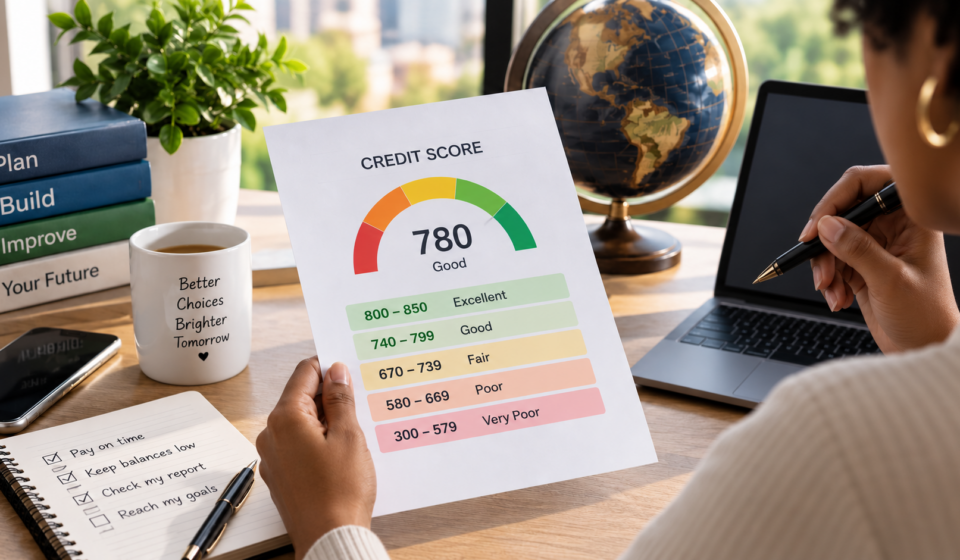

A credit score may be only three digits, but those numbers can affect some of your biggest financial decisions.
Your score can influence whether you qualify for a credit card, auto loan, mortgage, or other type of financing. It may also affect the interest rates and borrowing terms you receive.
But what does your credit score actually mean?
Is 650 good? Is 700 enough? Is there a meaningful difference between a 740 and an 800?
The answer depends partly on which credit-scoring model is being used.
Two of the best-known models in the United States are FICO® Score and VantageScore®. Both commonly use a 300–850 scale, but they divide that scale into different credit-score ranges.
In this guide, we’ll explain what the different credit score ranges mean, compare FICO and VantageScore, and show you how to interpret your number without becoming overly focused on a single score.
What Is a Credit Score?
A credit score is a numerical estimate of the risk involved in lending money to a consumer.
Credit-scoring models analyze information contained in your credit reports to estimate how likely you are to repay borrowed money as agreed.
The Consumer Financial Protection Bureau explains that many credit scores range from 300 to 850, although different scoring companies may use different models and ranges.
Generally:
- Higher credit scores indicate lower predicted credit risk.
- Lower credit scores indicate higher predicted credit risk.
However, you do not have just one credit score.
Your scores can differ depending on:
- The scoring model being used
- The version of the scoring model
- Which credit bureau supplied the information
- The type of loan or financial product
- Changes to your credit report
- When the score was calculated
This is why the score shown in your banking app may not be exactly the same score a mortgage lender, auto lender, or credit card issuer sees.
What Is a Good Credit Score?
For a standard FICO® Score, 670 to 739 is considered Good.
A score of 740 to 799 is Very Good, while scores of 800 and above are considered Exceptional.
But there is no single score that guarantees approval for a loan or credit card.
Lenders may establish their own minimum score requirements and evaluate other information such as your income, existing debt, payment obligations, down payment, and the type of credit you are seeking.
The best way to interpret your score is therefore to think of it as a measure of credit risk rather than a guaranteed approval or rejection number.
FICO Credit Score Ranges Explained
Base FICO Scores generally range from 300 to 850.
Here are FICO’s standard credit-score categories:
| FICO Score | Rating | General Interpretation |
| 300–579 | Poor | Higher predicted lending risk |
| 580–669 | Fair | Below stronger credit ranges but financing may still be available |
| 670–739 | Good | Generally viewed favorably by many lenders |
| 740–799 | Very Good | Lower predicted credit risk |
| 800–850 | Exceptional | Very low predicted credit risk |
300–579: Poor Credit
A FICO Score below 580 is considered Poor.
Consumers in this range may have more difficulty qualifying for certain credit products. When financing is available, the borrower may face higher interest rates, smaller credit limits, larger deposits, or less favorable loan terms.
A score in this range can be associated with issues such as:
- Missed or late payments
- Collection accounts
- High credit-card balances
- Defaults
- Serious negative credit events
- A limited or recently damaged credit history
However, having a poor credit score does not mean your score has to remain there permanently.
Credit scores can change as the information in your credit reports changes.
580–669: Fair Credit
FICO Scores between 580 and 669 are considered Fair.
Consumers in this range may still qualify for loans and credit cards, but they may not receive the same rates and terms offered to borrowers with stronger credit profiles.
If your score falls within this range, strengthening your payment history and reducing revolving balances may help improve your credit profile over time.
670–739: Good Credit
A FICO Score between 670 and 739 is classified as Good.
Many lenders generally consider consumers within this range to have good credit.
Being in the Good range may improve your ability to qualify for competitive loans and credit products, although approval and pricing still depend on the lender.
Is 700 a Good Credit Score?
Yes.
Under FICO’s standard ranges, a 700 credit score falls within the Good category.
That doesn’t mean every person with a 700 score receives identical loan terms. A lender can still evaluate factors beyond the score itself.
740–799: Very Good Credit
Scores from 740 to 799 fall within FICO’s Very Good range.
Borrowers in this category generally represent lower predicted credit risk.
A score in this range may help consumers qualify for competitive interest rates and financial products, although the best available offer depends on the lender and type of financing.
Is 750 a Good Credit Score?
Yes. A 750 FICO Score is considered Very Good, placing it above the Good category.
However, moving from 750 to 800 does not necessarily mean every lender will offer significantly better terms. Once a borrower reaches a strong credit range, other financial factors may become increasingly important.
800–850: Exceptional Credit
FICO Scores of 800 and above are considered Exceptional.
Consumers within this range generally demonstrate very low credit risk according to the scoring model.
People with exceptional credit often have characteristics such as:
- Long histories of on-time payments
- Low revolving-credit utilization
- Established credit accounts
- Few serious negative items
- Responsible use of different types of credit
Even an 850 score does not guarantee approval.
A lender may still decline an application because of income, debt levels, affordability, loan-specific requirements, or other underwriting criteria.
FICO vs. VantageScore Credit Score Ranges
FICO isn’t the only major credit-scoring model.
VantageScore also uses a scale of 300 to 850, but its categories are different.
VantageScore 4.0 divides consumers into four primary tiers:
| VantageScore 4.0 | Credit Tier |
| 300–600 | Subprime |
| 601–660 | Near Prime |
| 661–780 | Prime |
| 781–850 | Superprime |
This means the same numerical score may have a different category depending on the model.
For example:
A score of 665
- FICO: Fair
- VantageScore 4.0: Prime
That doesn’t mean one score is wrong.
It simply means FICO and VantageScore use different models and categories to estimate credit risk.
Why Is My FICO Score Different From My VantageScore?
Your FICO Score and VantageScore may differ because the models use different formulas and may weigh information differently.
Scores can also vary because:
- Your credit reports may not contain identical information at all three credit bureaus.
- Account information may be updated at different times.
- Different versions of the scoring models may be used.
- A lender may use an industry-specific credit score.
- Your consumer credit-monitoring service may display a different score than your lender uses.
Small differences between scores are therefore normal.
Credit Score Example: What Does a 715 Score Mean?
Imagine Jordan has a FICO Score of 715.
Under FICO’s standard ranges, Jordan’s score falls within the Good category of 670–739.
Suppose Jordan applies for an auto loan.
The lender may view a 715 score positively, but it probably won’t make its decision based on that number alone.
Depending on the lender, it may also consider:
- Jordan’s income
- Existing debt
- Monthly obligations
- Credit history
- Loan amount
- Down payment
- Information contained in Jordan’s credit report
Now imagine Jordan continues making every payment on time while reducing credit-card balances.
As those changes are reported to the credit bureaus, Jordan’s credit scores may change.
The important point is that 715 isn’t simply a “good number.” It represents a risk range within a particular scoring model.
What Factors Affect Your Credit Score?
Credit-scoring formulas vary, but several types of information commonly influence credit scores.
Payment History
Your history of making required payments is an important part of most credit-scoring models.
Late payments and other serious payment problems may negatively affect your credit profile.
Credit Utilization and Unpaid Debt
Credit utilization measures how much of your available revolving credit you’re currently using.
For example, if you have:
Total credit limits: $10,000
Current credit-card balances: $2,000
Your overall utilization would be:
$2,000 ÷ $10,000 × 100 = 20%
Using a large proportion of your available revolving credit may indicate greater credit risk.
Length of Credit History
Older, responsibly managed accounts can provide more information about how you’ve handled credit over time.
Scoring models may consider factors such as the age of your oldest account and the average age of your accounts.
New Credit
Applying for several credit accounts within a relatively short period can influence some scores.
A hard credit inquiry can appear when a lender reviews your credit in connection with an application.
Types of Credit
Credit-scoring models may also evaluate the types of accounts you’ve managed, such as:
- Credit cards
- Auto loans
- Mortgages
- Student loans
- Personal loans
You should not, however, open unnecessary accounts simply to create a more varied credit mix.
Serious Negative Information
Depending on the scoring model and credit report, serious negative events such as collections or bankruptcy may significantly affect your credit profile.
What Credit Score Do You Need to Get Approved?
There is no universal minimum credit score that guarantees approval.
Credit-score requirements depend on:
- The lender
- The type of loan
- The amount being borrowed
- Current underwriting standards
- The applicant’s overall financial situation
For example, the score needed for one credit card may differ significantly from the score needed for a mortgage.
Some lenders may also approve consumers with lower scores but charge higher interest rates or require different terms.
That is why asking “What credit score do I need?” is often only the beginning of the conversation.
Does a Higher Credit Score Always Mean a Lower Interest Rate?
A higher credit score can improve your chances of receiving favorable borrowing terms, but it does not guarantee the lowest available rate.
Interest rates may also depend on:
- Market interest rates
- Loan term
- Loan amount
- Down payment
- Debt-to-income ratio
- Lender pricing
- Type of financial product
- Other underwriting factors
In many cases, improving your credit profile before taking out a major loan may increase the number of competitive offers available to you.
How Can You Move Into a Better Credit Score Range?
There is no legitimate shortcut that guarantees a particular score increase.
Instead, focus on improving the information that your credit scores are based on.
1. Pay Your Bills on Time
Late payments can hurt your credit profile.
Setting up automatic payments or reminders can make missing a due date less likely.
2. Reduce Credit-Card Balances
Lowering revolving balances can reduce your credit utilization.
You don’t necessarily need to carry a balance to build credit. Paying your credit card responsibly and on time is what matters.
3. Avoid Unnecessary Credit Applications
Applying for credit you don’t need can add hard inquiries and potentially lead to additional new accounts.
Be selective about when you apply.
4. Keep Established Accounts When They Still Make Sense
Closing an older credit card may affect factors such as your available credit and account history.
That doesn’t mean you should keep every account forever, especially if it carries fees or no longer fits your financial needs. Consider the broader impact before closing an account.
5. Check Your Credit Reports for Errors
Your credit scores rely on information contained in your credit reports.
Incorrect late payments, unfamiliar accounts, incorrect balances, or other reporting errors can potentially affect your credit profile.
Review your reports regularly and dispute inaccurate information when necessary.
What Is the Highest Credit Score?
For standard base FICO Scores and VantageScore 4.0, the highest possible score is 850.
However, you generally do not need a perfect 850 to have excellent credit.
A consumer with a score in the upper credit ranges may already qualify for favorable terms depending on the lender and financial product.
Rather than chasing a perfect score, concentrate on maintaining the financial behaviors that produce a strong credit profile.
What Is the Lowest Credit Score?
Standard FICO Scores and VantageScore models commonly begin at 300.
A score near the bottom of the range indicates higher predicted credit risk, but credit scores are not permanent.
As negative information ages and positive information is added to your credit reports, your score may improve.
Why Your Credit Score Range Matters More Than a Few Points
Consumers sometimes become concerned when their score changes by a few points.
But small changes aren’t always financially significant.
For example, a score changing from 716 to 712 still leaves both scores within FICO’s Good category.
Lenders don’t necessarily make dramatically different decisions based on every individual point.
Your broader credit range, complete credit profile, and the lender’s underwriting rules can matter more than a minor day-to-day score fluctuation.
This is another reason not to become overly focused on achieving one exact number.

Frequently Asked Questions About Credit Score Ranges
What credit score is considered good?
For standard FICO Scores, 670–739 is considered Good. VantageScore 4.0 uses different categories, with 661–780 classified as Prime.
Is 600 a good credit score?
A FICO Score of 600 falls within the Fair range. Under VantageScore 4.0, 600 is within the Subprime tier.
Is 650 a good credit score?
A FICO Score of 650 is considered Fair. Under VantageScore 4.0, it falls within the Near Prime category.
Is 700 a good credit score?
Yes. A FICO Score of 700 falls within the Good range. Under VantageScore 4.0, 700 is considered Prime.
Is 750 a good credit score?
Yes. A 750 FICO Score falls within the Very Good range. Under VantageScore 4.0, it is within the Prime tier.
Is 800 a good credit score?
Yes. A FICO Score of 800 is considered Exceptional, while an 800 VantageScore 4.0 falls within the Superprime tier.
Is 850 a perfect credit score?
850 is the maximum score available under standard base FICO and current VantageScore models. However, having an 850 does not guarantee approval for every loan or credit card.
Why did my credit score change?
Credit scores can change when information in your credit reports changes. Updated balances, payments, new accounts, inquiries, account age, and negative information can all potentially affect your scores.
Why does my bank show a different credit score from my lender?
Different services may use different scoring models, model versions, credit bureaus, or reporting dates. It is normal for consumers to have multiple credit scores.
Final Thoughts
Understanding credit score ranges can help you put your number into context.
For standard FICO Scores:
- 300–579: Poor
- 580–669: Fair
- 670–739: Good
- 740–799: Very Good
- 800–850: Exceptional
VantageScore 4.0 uses a different system:
- 300–600: Subprime
- 601–660: Near Prime
- 661–780: Prime
- 781–850: Superprime
The most important lesson is that your credit score is a risk indicator—not a financial grade or a guarantee of approval.
Instead of obsessing over a few points, focus on the habits behind your score: make payments on time, manage balances responsibly, limit unnecessary applications, and review your credit reports for inaccurate information.
Over time, consistently responsible credit management can help you build a stronger credit profile and potentially improve the financial options available to you.
Disclaimer: This article is for general educational and informational purposes only and does not constitute individualized financial, credit, or lending advice. Credit-scoring models, lender requirements, interest rates, and underwriting standards vary.