
When people hear the term credit score, they often think of a three-digit number that can affect whether they qualify for a credit card, car loan, mortgage, or other type of financing.
But credit scoring does not work the same way everywhere.
There is no universal global credit score.
Different countries have their own credit bureaus, credit reporting laws, scoring systems, data sources, and lending practices. Even within the same country, different credit bureaus and lenders may calculate or interpret creditworthiness differently.
That means a credit score of 750 in one country may represent something very different—or may not even exist on the same scoring scale—in another.
Despite these differences, most credit systems share a similar purpose: helping lenders understand creditworthiness, or the likelihood that a borrower will repay money according to the agreed terms.
This guide compares how credit scores and creditworthiness work in several major countries and explains what these systems have in common.
What Is Creditworthiness?
Creditworthiness is an assessment of how likely a borrower is to repay money and how much risk a lender may take by extending credit to that person.
Depending on the country and scoring model, lenders and credit reporting organizations may consider factors such as:
- Whether loans and other credit obligations are paid on time
- How much debt a person currently owes
- How long the person has been using credit
- How much available revolving credit is being used
- How frequently the person applies for new credit
- Previous defaults, collections, insolvencies, or bankruptcies
- The types of loans and credit accounts the person has managed
The importance of each factor varies by country, credit bureau, scoring model, and lender.
A credit score can help summarize some of this information, but the score itself usually does not make the final lending decision.
Is There an International Credit Score?
No. There is currently no single international credit score that follows consumers everywhere in the world.
Credit reporting systems generally operate within individual countries or jurisdictions.
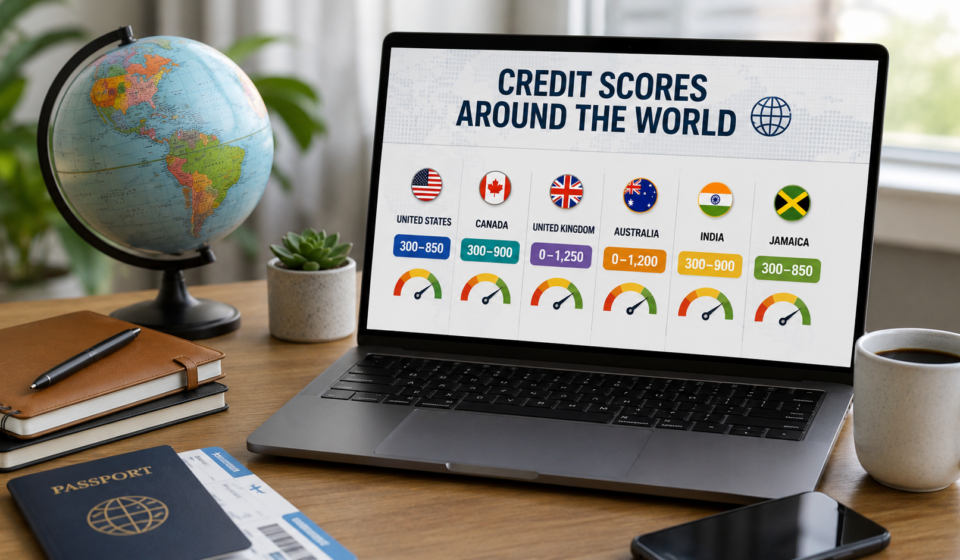
For example, the United States commonly uses scoring models with a 300–850 range, while Canada generally uses scores from 300–900. Australia’s scores can extend to either 1,000 or 1,200 depending on the credit reporting agency.
The United Kingdom is different again because credit reference agencies may use their own scoring ranges, while lenders apply their own approval criteria.
This makes direct international comparisons unreliable.
A 750 credit score in the United States, for example, should not automatically be treated as equivalent to a 750 score in Canada, India, Germany, or another country.
Credit Scores Around the World: Quick Comparison
| Country | Common Score Range or System | Key Point |
| United States | Many models use 300–850 | Multiple scores and scoring models are used |
| Canada | Generally 300–900 | Equifax and TransUnion are the two main credit bureaus |
| United Kingdom | Varies by credit reference agency | There is no single score used by every lender |
| Australia | 0–1,000 or 0–1,200 | Range depends on the credit reporting agency |
| Germany | SCHUFA’s newer score uses 100–999 | Uses a defined set of scoring criteria |
| India | Commonly 300–900 | Multiple regulated Credit Information Companies operate |
| China | Financial credit-reporting system | Should not be confused with one universal “social credit score” |
Important: Credit score ranges, models, and lender practices can change. Always check the relevant credit bureau, financial regulator, or consumer protection authority for current information.
How Credit Scores Work in Different Countries
United States: Multiple Scores, Often From 300 to 850
The United States has one of the world’s best-known consumer credit systems.
The three major nationwide credit reporting companies are:
- Equifax
- Experian
- TransUnion
These companies maintain credit reports containing information about consumers’ borrowing and repayment histories.
Many commonly used U.S. credit scores range from 300 to 850, although not every scoring model uses exactly the same range.
Consumers also don’t have just one credit score.
A person’s score can vary depending on:
- Which credit bureau supplied the information
- Which scoring model is used
- Which version of that model is used
- The type of credit being requested
- When the score was calculated
Common factors affecting U.S. credit scores include payment history, outstanding debt, credit utilization, age of credit accounts, recent credit applications, and the types of credit being managed.
Models such as FICO generally reward responsible credit behavior, including paying obligations on time and keeping revolving balances manageable relative to available credit.
However, even an excellent credit score does not guarantee approval. Lenders can consider income, existing debt, affordability, and their own underwriting requirements.
Canada: Credit Scores Generally Range From 300 to 900
Canada’s credit system shares some similarities with the United States, but the scoring range is different.
Canadian credit scores generally range from 300 to 900, with higher scores typically representing lower credit risk.
Canada’s two main credit bureaus are:
- Equifax
- TransUnion
Factors that can affect Canadian credit scores include:
- Payment history
- Outstanding debt
- How close balances are to credit limits
- Length of credit history
- Types of credit used
- Collections or insolvencies
- Frequency of new credit applications
Canadian consumers should also understand that the score from one bureau may differ from another because scoring formulas and available information can vary.
Does Your Foreign Credit History Transfer to Canada?
Not automatically.
Canada’s credit bureaus primarily build reports using credit activity reported within Canada.
As a result, someone who moves to Canada after years of responsible borrowing elsewhere may still need to establish a Canadian credit history.
Individual lenders may sometimes consider foreign financial information separately, but consumers should not assume their existing foreign score will automatically become a Canadian score.
United Kingdom: There Is No Single Universal UK Credit Score
The United Kingdom is a good example of why international credit score comparisons can be misleading.
The UK has several major credit reference agencies, and each can calculate consumer scores differently.
Experian UK’s newer consumer score, for example, uses a 0–1,250 range.
However, another credit reference agency may use a completely different scale.
More importantly, lenders do not simply look at a consumer-facing credit score and automatically approve or reject an application.
They may evaluate:
- Your credit report
- Your application information
- Income and expenditure
- Existing debts
- Their previous relationship with you
- Their own internal risk criteria
That means two lenders can reach different decisions about the same borrower.
So if someone in the UK says, “My credit score is 900,” the number alone doesn’t tell the whole story. You would also need to know which agency produced the score and which scoring scale was used.
Australia: Credit Scores Can Reach 1,000 or 1,200
Australia uses credit reports, credit ratings, and credit scores to help lenders assess borrowers.
Depending on the credit reporting agency, an Australian credit score may range from 0 to either 1,000 or 1,200.
Higher scores generally indicate that the borrower is considered lower risk.
Information that may affect an Australian credit score includes:
- Amounts borrowed
- Credit applications
- Repayment history
- Credit products held
- Defaults
- Certain insolvency information
Australia demonstrates another important principle: even within the same country, credit reporting organizations can use different scoring systems.
That is why consumers should pay attention to both the score and the scoring range.
Germany: Understanding the SCHUFA Score
Germany is well known for SCHUFA, a major credit information organization used by banks and other companies when evaluating creditworthiness.
SCHUFA’s newer scoring system uses a 100-to-999 point scale and is based on 12 criteria.
Those criteria examine different aspects of a consumer’s financial and credit history.
One important point is that SCHUFA itself does not make the final decision about whether a consumer receives a loan or enters into a contract.
Banks and other companies can combine SCHUFA information with their own data and lending criteria when making decisions.
This distinction applies in many countries: a credit bureau provides information or risk assessments, while the lender ultimately decides whether to approve the application.
India: CIBIL and the 300-to-900 Credit Score
India has multiple Credit Information Companies operating within a regulated credit-reporting framework.
One of the country’s best-known consumer scores is the TransUnion CIBIL Score.
CIBIL Scores range from 300 to 900, with higher scores generally indicating a stronger credit profile.
Factors that may influence a CIBIL Score include:
- Payment history
- Credit utilization
- Number of recent credit inquiries
- Types of credit accounts
- Length and depth of credit history
Banks and other lenders can use credit information alongside other financial information when evaluating applications.
As with other countries, the credit score is an important risk indicator—but it is not necessarily the only factor considered.
China: Financial Credit Reporting Is Not a Universal “Social Credit Score”
China’s system requires additional explanation because consumer financial credit reporting is frequently confused with the country’s broader social credit policies.
The People’s Bank of China’s Credit Reference Center operates financial credit-reporting infrastructure that maintains information about individuals’ and businesses’ credit activity.
Consumers can obtain personal credit reports through authorized channels.
This financial credit-reporting system should not be described as one nationwide FICO-style “social credit score.”
China also has broader government social-credit policies involving regulatory records, public credit information, incentives, restrictions, and credit management in different sectors.
These systems are more complex than the popular idea that every Chinese citizen simply receives one government-controlled number determining every part of daily life.
For consumers trying to understand international financial credit, the important distinction is:
Financial credit reporting and China’s broader social-credit framework are not the same thing.
Example: The Same Borrower in Different Countries
Imagine a fictional borrower named Maya.
Maya has:
- Never missed a credit payment
- Maintained credit accounts for five years
- The equivalent of a $10,000 credit card limit
- An outstanding balance equivalent to $2,000
- One installment loan
- Only one recent application for additional credit
Her revolving credit utilization would be:
$2,000 ÷ $10,000 × 100 = 20%
Maya demonstrates several financial behaviors that many credit systems may view positively.
But the way those behaviors are measured can differ dramatically depending on where she lives.
If Maya lived in the United States
Her on-time payments, established credit history, and relatively low utilization could generally contribute positively to her credit profile.
If Maya lived in Canada
Similar factors—including payment history, debt levels, account age, and balances relative to credit limits—could affect her creditworthiness, but her score would generally be expressed on a scale of 300–900.
If Maya lived in Australia
Her repayment history, borrowing level, and number of credit applications could influence a score running to either 1,000 or 1,200, depending on the reporting organization.
If Maya lived in Germany
SCHUFA would assess her using its own scoring methodology and defined criteria, producing a result on its 100–999 scale.
If Maya lived in India
A CIBIL model could consider her payment behavior, utilization, inquiries, and other credit information and produce a score within the 300–900 range.
The lesson is simple:
Good financial habits can be valuable internationally, but credit scores themselves generally cannot be converted directly from one country’s system to another.

What Do Credit Systems Around the World Have in Common?
Although scoring systems vary, several principles appear repeatedly.
Paying on Time Matters
Payment history is an important indicator of borrowing behavior in many credit systems.
Repeated late payments, defaults, or accounts sent to collections can make a borrower appear riskier.
Your Debt Matters
Lenders want to understand how much debt you already have and whether taking on additional borrowing is financially manageable.
In systems that consider revolving utilization, consistently carrying balances close to your available credit limits may also affect your credit profile.
Credit History Matters
An established record of responsible borrowing gives lenders and scoring models more information about how you have handled credit over time.
Frequent Credit Applications Can Matter
Applying for numerous credit products over a short period may influence credit assessments in several countries.
The exact effect depends on the country’s reporting system and scoring model.
Your Score Is Only Part of the Decision
A credit score should not be confused with a guaranteed approval or rejection.
Depending on the country and lender, additional factors may include:
- Income
- Employment
- Existing financial obligations
- Affordability
- Loan amount
- Loan type
- Assets or collateral
- Internal lender risk policies
Two consumers with similar credit scores may therefore receive different lending decisions.
Can You Take Your Credit Score With You When You Move to Another Country?
Usually, you should not assume your credit score will automatically transfer when you move abroad.
Credit-reporting systems operate under different laws, databases, financial institutions, and reporting networks.
For example, someone with years of excellent credit history in the United States may move to Canada, the UK, Australia, or another country and discover that the local credit system does not automatically recognize their previous score.
This can be particularly important for:
- Immigrants
- International students
- Expatriates
- People relocating for work
- Returning residents
You may need to establish credit within your new country’s financial system.
Some lenders or specialized financial services may consider foreign financial records, but practices vary significantly.
How to Build Good Credit in a New Country
If you have recently relocated, start by learning how the local credit-reporting system works.
Helpful steps may include:
- Check whether you have a local credit report. Find out which credit bureaus operate in your new country and how consumers can access their information.
- Pay financial obligations on time. Building a consistent repayment history is important in many credit systems.
- Use credit carefully. Avoid taking on more debt than you can comfortably repay.
- Limit unnecessary applications. Applying for numerous accounts immediately after relocating may not help your credit profile.
- Review your credit information for errors. Incorrect information can potentially affect how lenders evaluate you.
- Use official local resources. Financial regulators, consumer protection agencies, and recognized credit bureaus are generally the best places to learn how your country’s system works.
Frequently Asked Questions About International Credit Scores
Is there one global credit score?
No. There is no single worldwide consumer credit score. Countries use different credit bureaus, reporting systems, scoring models, and lending criteria.
Which country has the highest credit score?
There is no meaningful worldwide “highest credit score” because scoring scales are different.
A maximum score of 850 in one model cannot simply be compared with 900, 1,000, 1,200, or 1,250 in another.
Does my U.S. credit score work internationally?
Usually not directly.
Your U.S. credit score is based primarily on information within the U.S. credit-reporting system. Foreign lenders may have different methods for evaluating your financial history.
Does credit history transfer between countries?
Not automatically in most cases. A lender may sometimes consider foreign financial information, but you may still need to establish a local credit history after moving.
Why do credit score ranges differ between countries?
Different credit bureaus and scoring companies develop their own models for predicting lending risk. As a result, the underlying data, formulas, ranges, and definitions can differ.
Is a 750 credit score good everywhere?
No.
A score of 750 cannot be interpreted without knowing the country, credit bureau, scoring model, and overall score range.
Final Thoughts
Credit scores may look like simple numbers, but the systems behind them can vary significantly from country to country.
The United States commonly uses models ranging from 300–850. Canada generally uses a 300–900 scale. Australian scores can extend to 1,000 or 1,200. Experian UK’s current consumer score extends to 1,250, while Germany’s newer SCHUFA score uses a 100–999 scale.
Those numbers should not be compared directly.
Instead of focusing on whether your score matches someone in another country, focus on the financial behaviors that commonly demonstrate creditworthiness:
- Pay your obligations on time.
- Manage debt carefully.
- Avoid borrowing more than you can reasonably repay.
- Apply for new credit thoughtfully.
- Review your credit information for errors.
- Learn how credit works in the country where you live.
Whether you’re building credit for the first time or moving to a new country, understanding the local credit system can help you make better financial decisions and prepare for future borrowing opportunities.
Disclaimer: This article is for educational and informational purposes only and does not constitute financial, legal, or credit advice. Credit-scoring systems, score ranges, regulations, and lender policies can change. Individual lenders may use different criteria when making lending decisions.