

Have you ever wondered why one person qualifies for a low-interest mortgage while another is offered a much higher rate—or is denied altogether?
One of the biggest factors lenders consider is your credit score. Whether you’re applying for a credit card, auto loan, mortgage, or personal loan, your credit score helps lenders evaluate how likely you are to repay borrowed money.
But how are credit scores actually calculated?
The answer isn’t as simple as plugging numbers into a calculator. Credit scores are generated using sophisticated scoring models that analyze information from your credit reports. Different companies use different scoring models, which is why you may have more than one credit score.
In this guide, we’ll explain how credit scores are calculated, the five major factors that influence a typical FICO® Score, and practical steps you can take to build stronger credit over time.
What Is a Credit Score?
A credit score is a three-digit number that estimates how likely you are to repay borrowed money according to the agreed terms.
Credit scores are calculated using information found in your credit reports, which are maintained by the major credit reporting agencies.
Many commonly used credit scoring models use a range of 300 to 850, although not every scoring model uses the same scale.
Generally speaking:
- Higher scores indicate lower lending risk.
- Lower scores indicate higher lending risk.
It’s also important to know that you don’t have just one credit score. Different lenders may use different scoring models, versions, or data from different credit bureaus, so the score a lender sees may differ from the one you view yourself.
How Are Credit Scores Calculated?
Credit scoring companies use proprietary mathematical algorithms to analyze the information in your credit report.
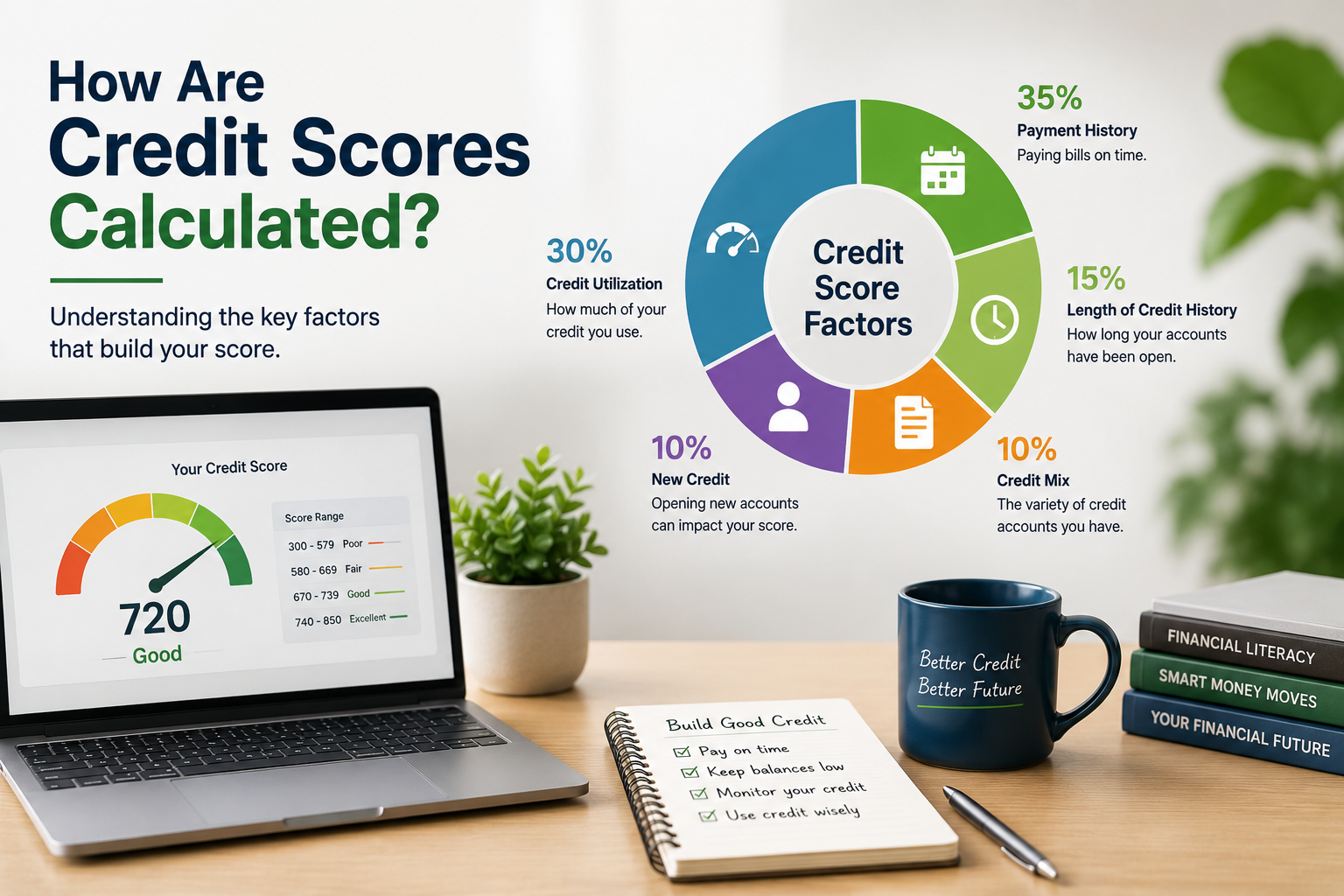
While the exact formulas are not publicly available, the best-known scoring model—the FICO® Score—groups information into five major categories.
These categories represent their approximate importance for the general population, but the impact of each factor varies depending on your individual credit profile.
The Five Main Factors That Affect Your FICO® Score
1. Payment History (About 35%)
Payment history is generally the most influential factor in a typical FICO® Score.
Scoring models review whether you’ve paid your credit obligations on time. Late payments, collections, bankruptcies, and other serious negative events may lower your score, while consistently paying as agreed helps demonstrate responsible credit management.
Example
Maria has had a credit card for three years.
She has never missed a payment and always pays at least the minimum amount by the due date.
That consistent payment history contributes positively to her overall credit profile.
Key takeaway: Paying your bills on time is one of the most effective ways to build and maintain healthy credit.
2. Amounts Owed (About 30%)
The second-largest factor is amounts owed, particularly your credit utilization ratio.
Credit utilization measures how much of your available revolving credit you’re currently using.
Example
Suppose you have:
- Credit limit: $5,000
- Current balance: $1,000
Your credit utilization is:
$1,000 ÷ $5,000 × 100 = 20%
Many financial experts recommend keeping credit utilization below 30%, although lower utilization is generally considered more favorable.
High utilization doesn’t necessarily mean you’ve done something wrong, but it may indicate greater borrowing risk.
3. Length of Credit History (About 15%)
Scoring models also consider how long you’ve been using credit.
Factors include:
- Age of your oldest account
- Age of your newest account
- Average age of all accounts
- Length of time specific accounts have been active
A longer history of responsible credit management gives lenders more information about your borrowing habits.
However, FICO notes that you do not need decades of credit history to achieve a good credit score.
4. New Credit (About 10%)
Opening several new credit accounts within a short period may affect your credit score.
Each application may generate a hard inquiry, and multiple recent applications can indicate increased borrowing risk.
This doesn’t mean you should avoid applying for credit altogether.
Instead, apply only when necessary and avoid submitting multiple applications within a short time-frame unless appropriate (such as certain rate-shopping situations, which some scoring models treat differently).
5. Credit Mix (About 10%)
Credit mix refers to the different types of credit accounts you’ve successfully managed.
Examples include:
- Credit cards
- Auto loans
- Mortgages
- Student loans
- Personal loans
- Retail financing accounts
Having experience managing different types of credit may benefit your overall credit profile.
However, you should never open new accounts solely to improve your credit mix.

Credit Score Example
Let’s look at a realistic example.
Jordan’s Credit Profile
Jordan has:
- One credit card open for five years
- Total available credit of $10,000
- Current balance of $1,500
- One auto loan paid on time every month
- No missed payments
- No collections
- One new credit application during the past year
Jordan’s credit utilization is:
$1,500 ÷ $10,000 × 100 = 15%
Jordan demonstrates several characteristics commonly associated with stronger credit:
- Excellent payment history
- Low credit utilization
- Established credit history
- Experience managing multiple types of credit
- Limited recent credit applications
Can You Calculate Jordan’s Exact Credit Score?
No.
Many people mistakenly assume they can calculate a FICO® Score by multiplying each category by its percentage.
That’s not how credit scoring works.
The percentages (35%, 30%, 15%, 10%, and 10%) represent the relative importance of the categories, not a public scoring formula.
FICO uses proprietary algorithms that evaluate hundreds of relationships within your credit report.
Two people with similar payment histories and utilization rates can still have different scores because every credit profile is unique.
What Doesn’t Affect Your FICO® Score?
Many people believe income or employment directly determines their credit score.
That’s a common misconception.
According to FICO, the following are not used when calculating a FICO® Score:
- Income
- Employment status
- Salary
- Occupation
- Age (except as permitted by law)
- Race
- Religion
- Marital status
- Nationality
However, lenders may separately consider some of this information when deciding whether to approve a loan application.
Your credit score and a lender’s approval decision are not the same thing.
How Can You Improve Your Credit Score?
Improving your credit score usually requires consistent financial habits over time.
Here are some proven strategies:
- Pay every bill on time.
- Keep credit card balances low.
- Avoid applying for unnecessary credit.
- Maintain older credit accounts when appropriate.
- Review your credit reports regularly.
- Dispute inaccurate information promptly.
- Reduce outstanding debt over time.
There are no legitimate shortcuts that guarantee a specific score increase, but responsible credit management can help strengthen your credit profile.
Frequently Asked Questions
Can I calculate my own credit score?
Not exactly.
Credit scoring companies use proprietary formulas that are not publicly available. However, understanding the major scoring factors can help you make informed financial decisions.
Why do I have more than one credit score?
Different lenders use different scoring models, scoring versions, and credit bureau data. As a result, it’s normal to have multiple credit scores.
Does checking my own credit score lower it?
No.
Checking your own credit score is generally considered a soft inquiry, which does not affect your credit score.
Is paying off debt always good for my credit score?
Paying down debt is generally beneficial for your overall financial health and may improve your credit profile, particularly if it reduces your credit utilization. However, changes in your score depend on your complete credit report and the scoring model being used.
Final Thoughts
Credit scores may seem mysterious, but the underlying concept is straightforward.
Credit scoring models analyze how you’ve managed credit in the past to estimate the likelihood that you’ll repay borrowed money in the future.
For a typical FICO® Score, the five primary categories are:
| Factor | Approximate Importance |
| Payment History | 35% |
| Amounts Owed | 30% |
| Length of Credit History | 15% |
| New Credit | 10% |
| Credit Mix | 10% |
Remember, these percentages are guidelines—not a scoring formula.
The best long-term strategy isn’t chasing a specific number. It’s developing responsible financial habits that support strong credit over time.